
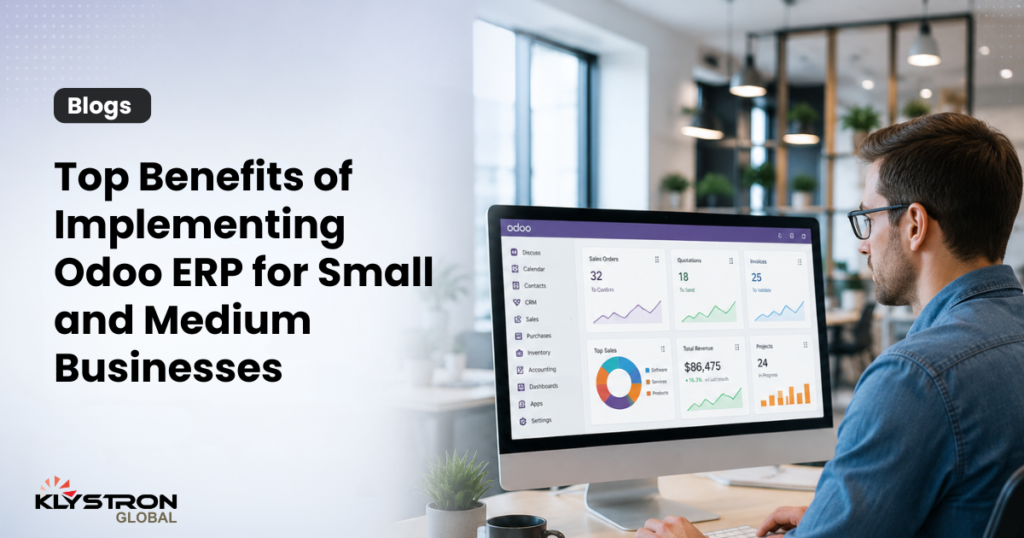
As sales increase, customer expectations evolve, and teams expand, managing disconnected systems and manual processes can quickly become a bottleneck.
Many small and medium-sized businesses (SMBs) rely on separate tools for accounting, sales, inventory, purchasing, and customer management. While these solutions may work initially, they often lead to duplicated data, limited visibility, and inefficient workflows.
This is where Odoo ERP makes a difference. As an all-in-one business management platform, Odoo helps organizations unify their operations, automate routine tasks, and gain real-time insights to support smarter decision-making. In this blog, we’ll explore the key benefits of implementing Odoo ERP and why partnering with experienced Odoo implementation partners is essential for long-term success.
Odoo ERP is a modular, open-source enterprise resource planning platform that helps businesses manage their operations through a unified ecosystem of integrated applications.
Organizations can implement only the modules they need and expand the system as their business grows.
Popular Odoo modules include:
This flexibility makes Odoo a practical solution for businesses looking to streamline operations without investing in multiple disconnected applications.
As businesses grow, operational challenges become increasingly difficult to manage without a centralized system.
Common challenges include:
An ERP system addresses these challenges by bringing all core business functions into a single platform, enabling teams to work more efficiently and make informed decisions.
Instead of switching between different software applications, teams can access sales, finance, inventory, purchasing, customer information, and reporting from one centralized system.
Odoo automates repetitive workflows such as invoice generation, purchase approvals, inventory updates, sales order processing, customer follow-ups.
Odoo provides interactive dashboards and customizable reports that offer real-time visibility into key business metrics. You can monitor sales performance, revenue trends, inventory levels, customer activities, project progress.
The integrated CRM module enables businesses to track leads, manage sales opportunities, monitor customer interactions, automate follow-ups, and improve customer communication. A centralized view of every customer interaction helps sales teams build stronger relationships and improve conversion rates.
Odoo enables businesses to manage inventory more efficiently through real-time stock tracking, automated replenishment, barcode integration, warehouse management and purchase planning
Unlike many traditional ERP systems, Odoo’s modular architecture allows businesses to start small and expand over time. Organizations can implement essential modules initially and add additional capabilities as business requirements evolve.
Every organization has unique workflows that standard software may not fully support. Through professional Odoo customization services, businesses can adapt modules, workflows, dashboards, and reports to align with their specific operational requirements.
Odoo connects every department through a unified platform where information flows automatically between teams. For example sales automatically updates inventory, inventory triggers purchasing, purchasing updates accounting, accounting tracks payments, management monitors performance.
As organizations grow, they introduce new products, expand into new markets, hire additional employees, and adopt new technologies. An ERP platform should evolve alongside these changes rather than limit future growth.
One of the key strengths of Odoo ERP is its modular architecture, which allows businesses to expand capabilities as their operational needs evolve. Instead of replacing the entire system, organizations can add new applications and functionality when required.
As businesses continue their digital transformation journey, Odoo supports future growth through:
This flexibility allows small and medium-sized businesses to invest in an ERP platform that continues delivering value as the organization evolves, making Odoo a long-term technology investment rather than a short-term operational solution.
Empower your organization with Odoo ERP solutions tailored to your business needs. At Klystron Global, our experienced team provides end-to-end Odoo implementation services, Odoo ERP development services, and Odoo customization services to help businesses streamline operations, improve productivity, and accelerate digital transformation.
From first-time Odoo ERP implementations to system upgrades and expansions, as certified Odoo partner we deliver tailored solutions designed to support your business growth.
Odoo can help SMEs centralize business operations, automate repetitive tasks, improve data visibility, reduce manual work, streamline workflows, and support better decision-making through real-time information.
Yes. By automating routine processes and reducing duplicate data entry, manual errors, and the need for multiple disconnected software systems, Odoo can help businesses improve operational efficiency and control costs.
Odoo is an integrated ERP platform that brings business functions such as accounting, sales, CRM, inventory, purchasing, manufacturing, HR, and project management into one system.
Yes. Odoo can be configured and customized to match an organization’s workflows, industry requirements, approval processes, reports, and other business needs.
Odoo ERP is suitable for businesses across various industries, including manufacturing, retail, e-commerce, logistics and supply chain, wholesale and distribution, professional services, construction, healthcare, hospitality, food and beverage, automotive, and IT services. Its modular approach allows businesses to select and customize applications according to their specific industry requirements.
Empowering businesses with innovative digital transformation for future success
Klystron, Inc.
3020 Bernal Ave, Ste 110-404
Pleasanton, CA 94566
USA | UAE | Bahrain | Oman | India
Email: sales.us@klystronglobal.com
Phone: +1 925 469 8820