
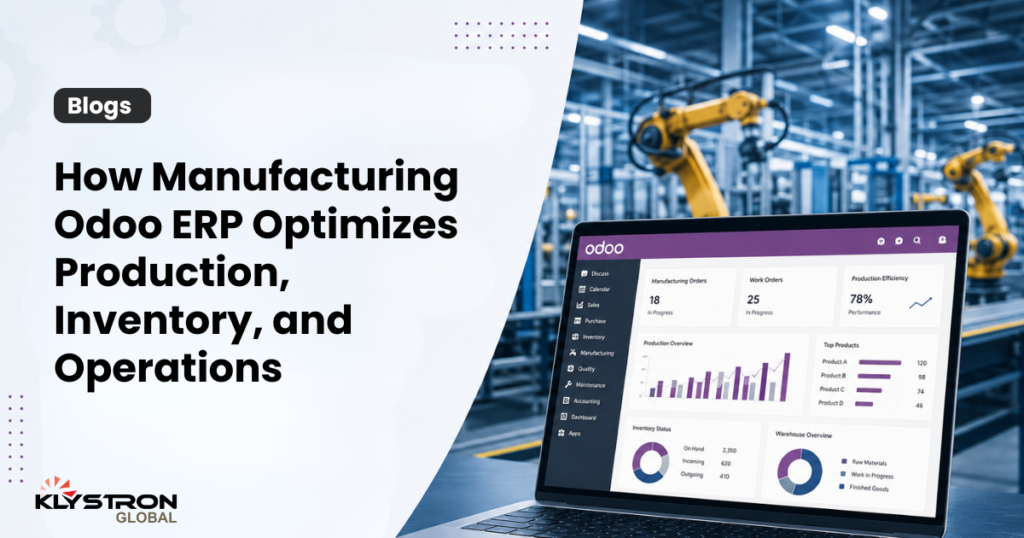
Disconnected software, manual planning, and inventory inefficiencies can limit productivity and increase operational costs. Manufacturing Odoo ERP brings every stage of the production lifecycle into a single, integrated platform. From production planning and inventory management to procurement and shop floor operations, it helps manufacturers streamline processes, improve visibility, and make faster, data-driven decisions.
In this blog, we’ll explore how Manufacturing Odoo ERP optimizes production, inventory, and business operations while helping manufacturers build a more agile and scalable business.
Without a centralized ERP platform, manufacturers often experience challenges such as:
A modern ERP system eliminates these operational gaps by connecting production, inventory, purchasing, sales, finance, and warehouse management into one unified ecosystem.
Production planning is one of the most critical functions within any manufacturing business. Manufacturing Odoo ERP helps businesses create accurate production schedules based on real-time demand, inventory availability, manufacturing capacity, and procurement timelines.
Key Capabilities
Business Benefits
Inventory plays a critical role in manufacturing profitability. Both overstocking and stock shortages can negatively affect production schedules and cash flow.
Odoo ERP provides real-time inventory visibility across warehouses, production units, and storage locations, helping manufacturers maintain optimal inventory levels without unnecessary manual intervention.
The system continuously updates stock levels as materials are received, consumed, or transferred throughout the production process.
Key Capabilities
Business Benefits
Managing Bills of Materials manually becomes increasingly complex as product variations and production volumes grow.
Manufacturing Odoo ERP allows manufacturers to create, manage, and update Bills of Materials while automatically generating work orders for every production process.
This ensures every production order follows standardized manufacturing procedures while maintaining consistency across production batches.
Key Capabilities
Business Benefits
It provides live visibility into every stage of production, allowing supervisors to monitor work orders, production progress, machine utilization, employee performance, and task completion from a centralized dashboard.
Instead of waiting for end-of-day reports, production managers can identify delays and respond immediately.
Key Capabilities
Business Benefits
Production schedules depend heavily on having the right materials available at the right time.
It connects purchasing directly with production planning, ensuring raw materials are automatically replenished based on manufacturing demand and inventory levels.
Key Capabilities
Business Benefits
Maintaining consistent product quality is essential for customer satisfaction and regulatory compliance. Manufacturing Odoo ERP integrates quality control directly into the production workflow, allowing manufacturers to define quality checkpoints, record inspection results, and track every stage of the manufacturing process. Combined with lot and serial number tracking, businesses can trace products from raw materials to final delivery.
Key Capabilities
Business Benefits
Manufacturing operations involve multiple teams working together—from procurement and production to warehouse management, sales, and finance. When departments operate in separate systems, communication gaps and duplicated work become common.
Manufacturing Odoo ERP creates a connected business environment where information flows automatically between departments.
Key Capabilities
Business Benefits
Unlock the full potential of Manufacturing Odoo ERP tailored to your production processes and business goals. At Klystron Global, our experienced team delivers end-to-end Odoo implementation services, Odoo ERP development services, and Odoo customization services to help manufacturers streamline operations, improve productivity, and scale with confidence.
Whether you’re implementing ERP for the first time or modernizing your existing manufacturing systems, our certified Odoo partners work closely with you to build a solution that supports sustainable growth and long-term operational success.
Odoo helps manufacturers automate workflows, coordinate departments, track production activities in real time, reduce manual processes, and improve overall operational efficiency.
Yes. Manufacturers can track raw materials, components, work-in-progress, and finished products throughout the production and inventory lifecycle.
Yes. Odoo connects manufacturing with inventory and purchasing, allowing material requirements to trigger procurement activities and helping ensure the right materials are available when needed.
Yes. Manufacturers can start with the modules they need and expand Odoo’s functionality as production volumes, facilities, workforce, and business operations grow.
Odoo can support a wide range of manufacturing businesses, including discrete manufacturing, process manufacturing, automotive, electronics, machinery, food and beverage, chemicals, textiles, and other production-based industries.
Empowering businesses with innovative digital transformation for future success
Klystron, Inc.
3020 Bernal Ave, Ste 110-404
Pleasanton, CA 94566
USA | UAE | Bahrain | Oman | India
Email: sales.us@klystronglobal.com
Phone: +1 925 469 8820